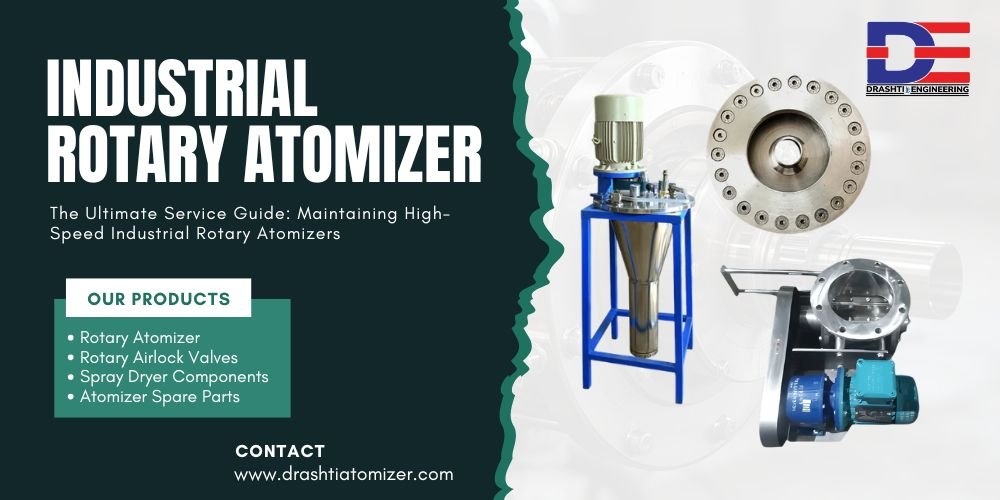
In heavy manufacturing and spray drying operations, your high-speed rotary atomizer is the heart of your production line. Spinning continuously at intense velocities—often between 12,000 and 24,000 RPM—this specialized machinery is subjected to massive centrifugal forces, heat, and material friction.
Because these systems run under such extreme physical stress, skipping routine maintenance is highly risky. A minor oversight can quickly transform a tiny operational imbalance into a catastrophic mechanical failure, resulting in bent drive shafts, ruined bearings, and hundreds of hours of lost production time.
As a premier manufacturer and technical service provider, Drashti Engineering has developed this practical maintenance guide to help your plant operators keep your atomization systems running smoothly, safely, and efficiently.
1. Daily Visual Inspection and Cleaning Protocols
The foundation of any successful maintenance program begins with cleanliness. Many sudden machine issues are caused by simple product accumulation. When processing dense chemical slurries, food ingredients, or abrasive ceramic slips, material can dry and stick inside the feed nozzles or along the outer edge of the spinning Rotary Atomizer Wheel.
When a wheel spins at high speeds, a weight variation of just a few grams on one side creates severe mechanical vibrations. At the end of every production shift, operators must flush the feed lines and thoroughly clean the atomizer apertures to prevent product crusting.
2. Monitoring High-Speed Spindle Bearings
The precision spindle bearings inside an atomizer housing absorb the heavy radial and axial loads generated during the spray drying cycle. Because these bearings rotate at extreme speeds, they require continuous, clean lubrication to prevent metal-to-metal friction and rapid heat generation.
- Temperature Checks: Operators should log bearing temperatures during operation. A sudden spike in heat usually indicates a breakdown in lubrication or the entry of fine powder dust past the primary seals.
- Acoustic Profiling: Listen for unusual whining, clicking, or grinding sounds coming from the spindle housing. Unusual noises are an early warning sign that the bearings are nearing the end of their operational lifespan and need immediate replacement.
3. Checking the Runout of the Rotary Shaft
The Rotary Shaft acts as the high-tensile spine of the entire machine assembly. Over months of continuous operation, the intense torque can cause subtle, micro-level deflections along the shaft body.
During scheduled maintenance shutdowns, technicians should use a high-precision dial indicator gauge to measure the shaft runout along the bearing journals. If the shaft straightness deviates even slightly from original engineering tolerances, it will cause a continuous, heavy wobble that can permanently damage the internal housing. Worn or bent shafts must be precision-ground or replaced entirely with a newly fabricated high-tensile shaft.
4. The Critical Role of Scheduled Dynamic Balancing
You cannot separate premium fabrication from precision balancing. Any replacement Atomizer Disc or wheel must be dynamically balanced on highly sensitive balancing machines before installation.
An unbalanced wheel introduces a parasitic bending moment along the axis of the shaft. This destructive bending force is directly related to the residual unbalance multiplied by the square of the rotational speed.
Because the mechanical stress increases drastically with the square of the speed, even a tiny residual unbalance at 18,000 RPM creates immense structural forces. Over time, these unchecked forces are fully capable of snapping a high-speed shaft or shattering precision bearings, leading to catastrophic system failure.
5. Managing the System Pressure Loop Downstream
A highly efficient atomization process requires a perfectly stable air profile inside the drying chamber. If the Rotary Airlock Valve installed at the base of your collection cyclone has worn-out seals or loose clearances, high-pressure air will leak backward up into the drying tower.
This upward air leakage creates turbulent counter-currents that push unevenly against the bottom of your spinning atomizer disc. This aerodynamic resistance creates artificial vibrations and forces wet material against the upper walls of the chamber. Regularly servicing your airlock valves is essential to protecting your upstream rotating assemblies.
Professional On-Site and Workshop Support
While daily cleanings can be handled by your factory operators, complex overhauls require specialized engineering tools. At Drashti Engineering, our dedicated Atomizer Service & Maintenance division provides full workshop testing, micro-level shaft alignment, taper matching, and high-sensitivity electronic dynamic balancing. Based in Ahmedabad, we provide global B2B operations with the technical expertise and high-grade replacement spare parts needed to maximize equipment lifetime.