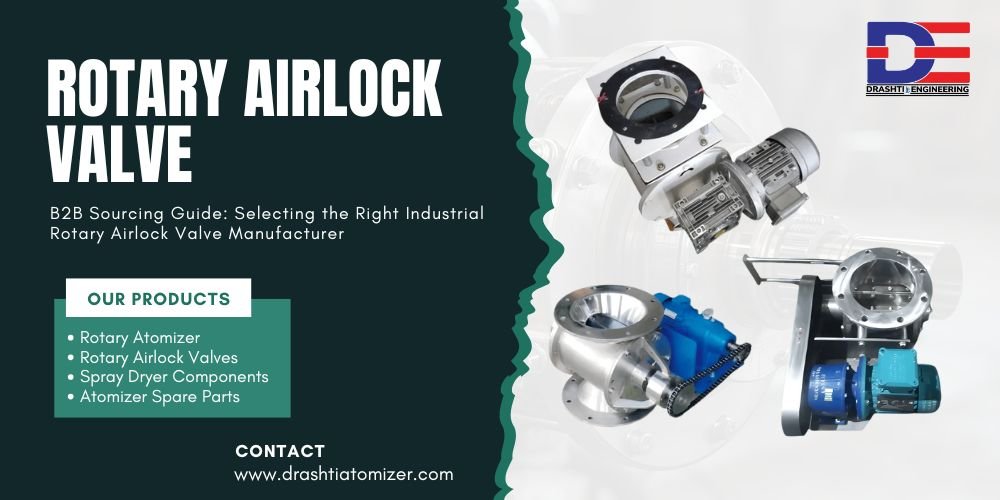
In large-scale bulk solid handling, pneumatic conveying, and dust collection systems, operational efficiency depends heavily on components that can hold a flawless seal under pressure. Positioned at the discharge points of cyclones, dust collectors, and hoppers, the Rotary Airlock Valve is the unsung workhorse of your production facility.
For B2B procurement officers, technical buyers, and plant engineers, sourcing these valves involves evaluating more than just the purchase price. A poorly fabricated airlock valve can lead to air leakage, rotor jamming, and frequent production stops. Choosing a dedicated, high-tier fabricator who understands industrial tolerances is essential to reducing your total cost of ownership.
As a trusted manufacturer, supplier, and exporter, Drashti Engineering has compiled this technical procurement guide to help you make informed sourcing decisions for your next industrial material handling project.
1. Demand Precision Rotor-to-Housing Clearances
The primary function of a rotary airlock valve is to continuously discharge powder or granules while maintaining a tight air seal between different pressure zones. The efficiency of this seal relies entirely on the clearance gap between the spinning rotor tips and the static housing wall.
When evaluating an industrial valve supplier, look for tight, engineered tolerances. At our Ahmedabad facility, we machine clearances strictly within a narrow window of 0.1 mm to 0.15 mm. If a manufacturer builds valves with clearances wider than 0.2 mm, high-pressure blow-by air will escape backward into your feeding system, disrupting material flow and forcing your blowers to consume excess energy.
2. Matching Rotor Pocket Design to Material Characteristics
A common sourcing mistake is purchasing a standard, generic valve for specialized materials. Different powders behave differently under pressure and friction. Your manufacturing partner should offer custom rotor pocket options:
- Open-End Rotors: Best for free-flowing, non-abrasive powders. They provide full-volume drop-through and are easy for maintenance teams to clean.
- Closed-End Rotors: Featuring welded shroud discs on the sides, these protect the outer valve housing from direct friction when handling highly abrasive materials or harsh chemicals.
- V-Shaped Pockets: Engineered specifically for sticky or cohesive powders, reducing material buildup inside the rotor pockets and ensuring consistent discharge volumes.
3. Material Selection and Housing Integrity
Heavy-duty industrial operations require rugged metallurgy. If you are operating in chemical, pharmaceutical, or food processing sectors, standard cast iron valves will not suffice due to corrosion risks.
Ensure your fabricator utilizes premium stainless steel grades, such as SS 304 or SS 316, or specialized hardened alloys for high-abrasion environments. Every casting and fabricated housing must be rigorously tested to handle your system’s specific pressure differentials without flexing or structural degradation.
4. Integration with Upstream Systems: The Closed-Loop Advantage
An efficient plant requires all material handling components to work in harmony. For instance, in a spray drying installation, your high-speed Rotary Atomizer Wheel relies on a stable, balanced pressure environment inside the drying tower to form a uniform atomization mist.
If the rotary airlock valve installed at the base of the collection cyclone leaks air, it creates turbulent upward counter-currents that travel straight back into the chamber. This air leak disrupts the uniform spray pattern coming from your atomizer disc, forcing wet particles against the upper walls of the drying tower. Sourcing precision-fabricated valves ensures your entire production loop remains fully pressurized and balanced.
5. Sourcing Directly from the Fabricator
When you purchase material handling equipment through trading middlemen, you run the risk of receiving generic components with long lead times for spare parts. Partnering directly with an established engineering manufacturer like Drashti Engineering offers key strategic advantages:
- Customization: Valves can be custom-machined to match your existing footprint, flange orientations, and motor specifications.
- Reliable Spares: Direct access to replacement parts, precision-ground Rotary Shafts, and maintenance support.
- Technical Compliance: Direct communication with the engineering team to ensure the valve meets your specific operational RPM and temperature requirements.