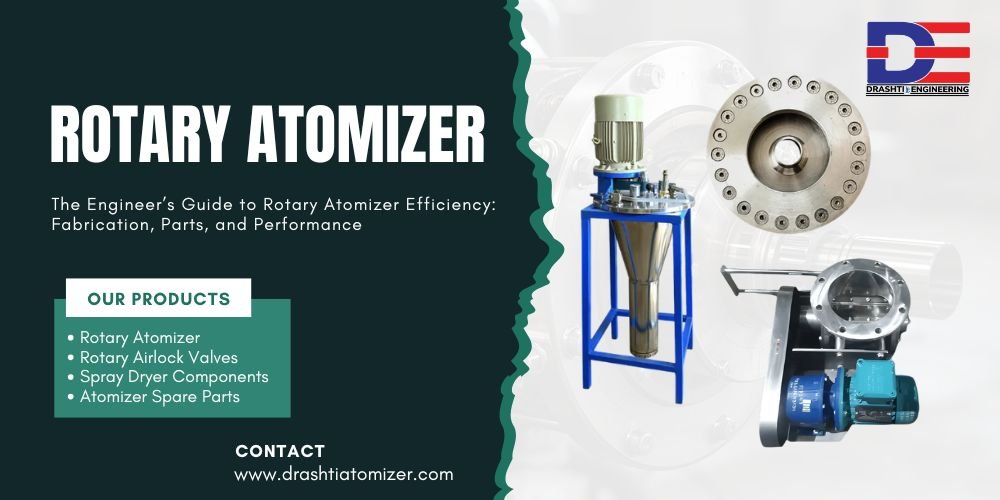
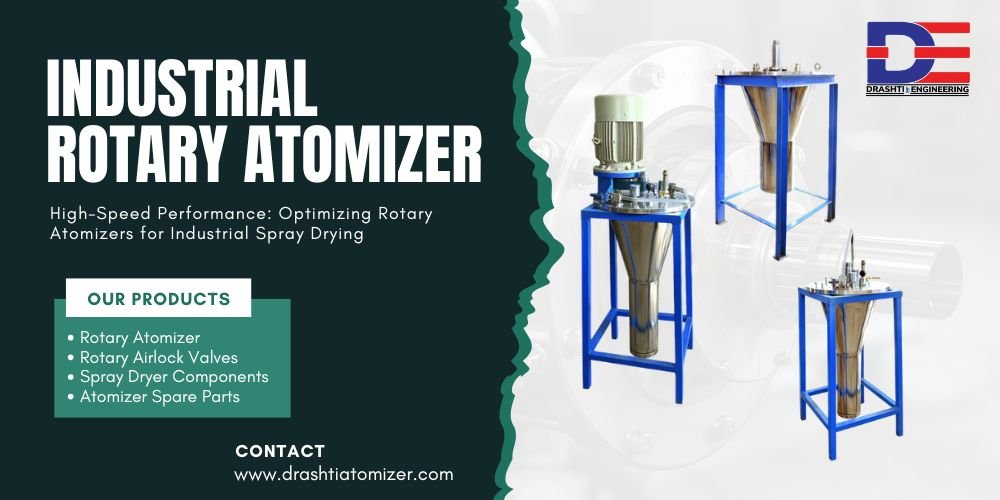
In the world of industrial processing, converting liquid feeds, concentrated slurries, and chemical solutions into fine, uniform dry powders requires exceptional mechanical control. The entire operational yield of an industrial spray drying tower relies heavily on a single, high-performance asset positioned at the top of the chamber: the Rotary Atomizer.
For plant engineers, production managers, and procurement officers, a rotary atomizer is not just a standard piece of machinery. It is an intricate, high-speed system that directly determines final product quality, moisture content, and particle size distribution. Sourcing your atomization equipment from a dedicated manufacturer who manages the entire fabrication, machining, and balancing process is critical to avoiding costly production inefficiencies.
As an established manufacturer, supplier, and custom fabricator, Drashti Engineering builds heavy-duty processing systems engineered to deliver absolute precision and long-term durability under continuous running conditions.
1. The Fluid Mechanics of High-Velocity Atomization
The primary objective of an industrial rotary atomizer is to instantly transform a continuous fluid feed into millions of micro-level droplets. As the liquid enters the center of the spinning assembly, it is aggressively accelerated outward by intense centrifugal force.
As the fluid reaches the outer edges of the high-speed Rotary Atomizer Wheel, it forms an ultra-thin liquid film. This film exits the discharge nozzles at extreme velocities, immediately shearing apart upon contact with the chamber air to form a highly controlled, symmetrical spray cloud. If the atomizer fails to maintain a consistent speed or a perfect fluid distribution, droplet sizes will vary. This leads to incomplete drying, poor powder quality, and wet product buildup on your chamber walls.
2. Sourcing Premium Metallurgy for Abrasive and Corrosive Slurries
Industrial spray dryers are utilized across vastly different sectors, from food-grade dairy powders to aggressive chemical catalysts, mineral slurries, and ceramic slips. Because the internal fluid channels experience continuous friction from these fast-moving liquids, material selection is everything.
At our Ahmedabad fabrication unit, we construct our atomizers using premium, corrosion-resistant stainless steel alloys like SS 316L. For plants handling highly abrasive slurries, standard steel faces rapid erosion. To prevent wear from altering the shape of your discharge ports, our custom fabrication team builds wheels with interchangeable, hardened inserts made from tungsten carbide or high-purity ceramics. This protects the core structure of your asset and extends its running life by hundreds of production hours.
3. The Precision Engineering Behind High-Tensile Shafts
An exceptional atomization disc requires an equally flawless drive system. The transmission of extreme rotational power—often ranging from 12,000 to over 22,000 RPM—places immense structural stress on the central Rotary Shaft.
To survive continuous torsional stress without bending, shafts must be fabricated from high-tensile forged alloys and finished using advanced cylindrical grinding machinery. We precision-grind shaft bearing journals down to micro-level straightness tolerances. This ultra-smooth finish eliminates micro-wobbles, reduces operating friction, keeps heat accumulation low, and protects your high-speed spindle bearings from premature failure.
4. The Absolute Necessity of Dynamic Balancing
You cannot separate premium fabrication from precision balancing. Any replacement Atomizer Disc or wheel must be dynamically balanced on highly sensitive balancing machines before installation.
An unbalanced wheel introduces a parasitic bending moment along the axis of the shaft. This destructive bending force is directly related to the residual unbalance multiplied by the square of the rotational speed.
Because the mechanical stress increases drastically with the square of the speed, even a tiny residual unbalance at 18,000 RPM creates immense structural forces. Over time, these unchecked forces are fully capable of snapping a high-speed shaft or shattering precision bearings, leading to catastrophic system failure.
5. Securing the System Loop with Downstream Components
To maximize your plant’s operational efficiency, your high-speed atomization must work in perfect harmony with your downstream material handling equipment. A spray dryer functions as a balanced pressure environment. If the Rotary Airlock Valve installed at the bottom of your collection cyclone suffers from loose clearances or worn seals, high-pressure air leaks backward into the system.
This upward air leakage creates turbulent counter-currents that travel straight back up the drying tower. When this rising air meets the descending mist coming from your atomizer wheel, it disrupts the uniform spray pattern, pushing wet material into the upper walls of the machine. Investing in precision-machined valves alongside your primary atomizer components ensures a completely balanced, zero-leakage production cycle.
Partner with Drashti Engineering
From manufacturing custom-engineered high-speed machinery to providing comprehensive, factory-wide Atomizer Service & Maintenance audits, Drashti Engineering is your trusted B2B partner. Based in Ahmedabad, we supply global processing industries with heavy-duty components designed to eliminate unplanned downtime and lower your overall cost of production. Contact our engineering desk today to discuss your custom processing requirements.