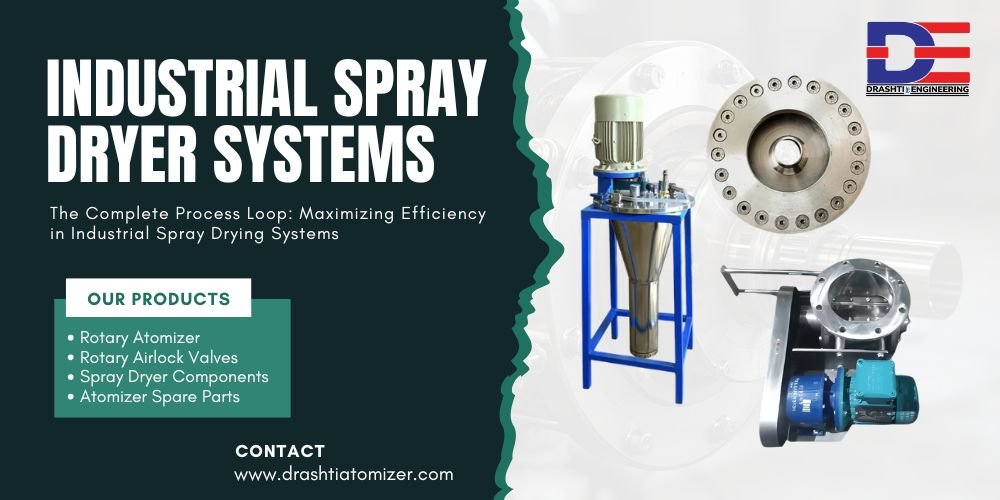
In heavy chemical processing, food manufacturing, and pharmaceutical production, a spray drying system is one of the most energy-intensive operations in the entire facility. Because these systems consume massive amounts of thermal and mechanical power, plant directors and operations heads are constantly looking for ways to optimize throughput, reduce energy bills, and eliminate material waste.
To achieve true efficiency, you cannot look at machine components in isolation. A spray dryer does not function as a collection of separate parts; it operates as a tightly closed pressure and aerodynamic loop. An inefficiency at the bottom of the system will directly hurt the performance of the high-speed machinery at the top.
As a premier manufacturer, supplier, and custom fabricator, Drashti Engineering builds fully integrated processing assets. Let’s examine how balancing your upstream atomization components with your downstream material handling hardware secures your entire production cycle.
1. Upstream Perfection: High-Velocity Atomization
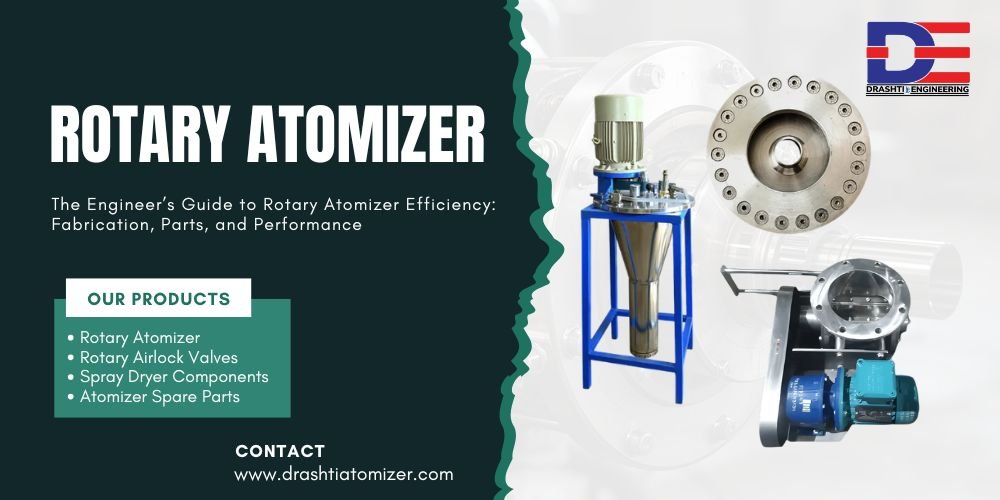
The spray drying process begins at the top of the tower, where a liquid slurry is instantly converted into a highly uniform mist inside the drying chamber. This demanding transition relies entirely on your high-speed Rotary Atomizer setup.
Operating at intense rotational velocities often exceeding 15,000 RPM, the atomizer must distribute fluids evenly to ensure rapid, consistent moisture evaporation. To maintain this high-velocity performance over long production cycles, every component—from the precision-ground Rotary Shaft to the wear-resistant Rotary Atomizer Wheel or Disc—must be engineered from high-tensile stainless steel alloys. Any minor structural flaw or imbalance here will distort the spray pattern, leading to partially wet powder dropping through the tower.
2. Downstream Security: Zero-Leakage Material Discharge
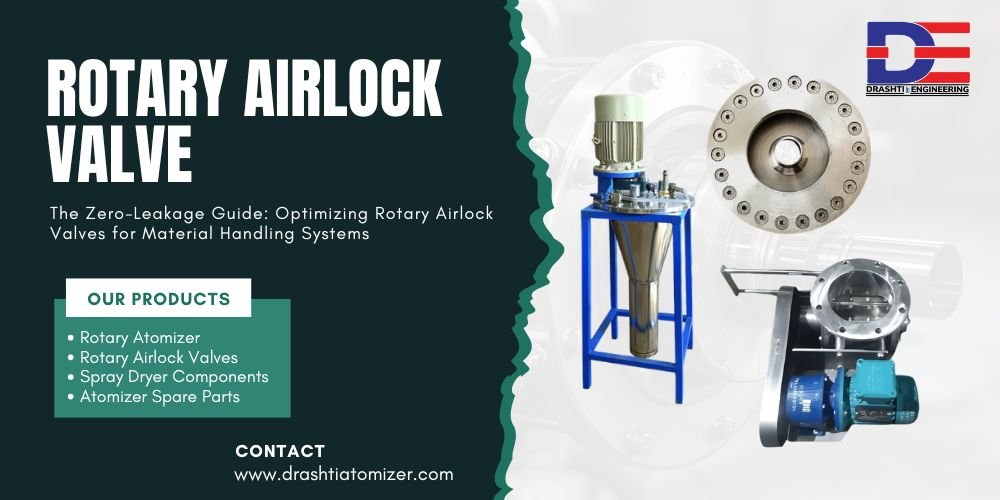
Once the atomized droplets interact with the hot air stream, they instantly dry into fine powders or granules and fall to the base of the collection cyclone. This is where the second critical phase of the loop begins, managed by the Rotary Airlock Valve.
The airlock valve faces a double challenge: it must continuously discharge the finished bulk powder into your packing lines while acting as a total pressure seal. If your valve is poorly fabricated or suffers from loose clearances, high-pressure air will leak backward, pushing straight up into the collection cyclone.
3. How Downstream Air Leakage Destroys Upstream Atomization
When a rotary airlock valve leaks air, the resulting upward counter-current creates turbulent air resistance inside the main drying tower. This aerodynamic turbulence travels all the way to the top of the chamber, where it disrupts the delicate, uniform mist expanding outward from your spinning atomizer disc.
Instead of falling gracefully through the hot air zone, the fine droplets are buffeted by the leaking air currents and thrown directly against the upper walls of the drying tower. This results in heavy product crusting, scorched material, frequent cleaning shutdowns, and diminished total product yield. By maintaining tight rotor-to-housing clearances of 0.1 mm to 0.15 mm on your discharge valves, you protect your upstream atomization patterns from costly air disturbance.
4. The absolute Necessity of Dynamic Balancing
You cannot separate premium fabrication from precision balancing. Any replacement Atomizer Disc or wheel must be dynamically balanced on highly sensitive balancing machines before installation.
An unbalanced wheel introduces a parasitic bending moment along the axis of the shaft. This destructive bending force is directly related to the residual unbalance multiplied by the square of the rotational speed.
Because the mechanical stress increases drastically with the square of the speed, even a tiny residual unbalance at 18,000 RPM creates immense structural forces. Over time, these unchecked forces are fully capable of snapping a high-speed shaft or shattering precision bearings, leading to catastrophic system failure.
5. Sourcing Your Entire System Loop from a Trusted Engineering Partner
When a factory sources its atomizer parts from one vendor, its valves from a trading middleman, and its maintenance from a third party, troubleshooting system issues becomes an operational nightmare. True process optimization requires a single, authoritative engineering partner who understands the entire mechanical loop.
At our fabrication unit in Ahmedabad, Drashti Engineering manages the entire design, casting, machining, and testing process under one roof. Whether you require an emergency supply of precision-machined Rotary Atomizer Spare Parts or a complete structural upgrade for your material handling layout, our integrated approach ensures your hardware works in perfect harmony.