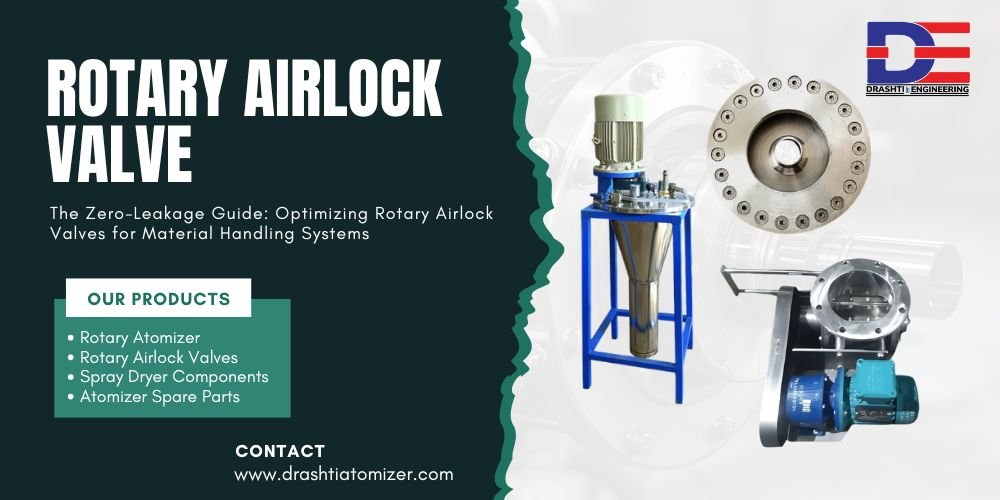
In bulk material handling and pneumatic conveying systems, maintaining a perfect pressure differential is everything. When dealing with fine powders, granules, or dust, your system relies entirely on one critical gatekeeper: the Rotary Airlock Valve.
For plant engineers and procurement heads, a poorly manufactured valve isn’t just a minor inconvenience—it is a direct source of material waste, system pressure loss, and inflated energy bills. As a dedicated manufacturer, supplier, and fabricator, Drashti Engineering builds valves engineered to eliminate these exact vulnerabilities.
1. The Cost of Air Leakage in Pneumatic Conveying
A rotary airlock valve must perform two jobs simultaneously: continuously discharge bulk solids while acting as a precise air seal. When a valve experiences excessive rotor-to-housing leakage, high-pressure air escapes backward into the feeding hopper.
This blow-by air creates an upward counter-current that restricts material flow, causes product bridging, and forces your blowers to work harder. The result? Decreased system throughput and escalated power consumption.
2. The Solution: Precision Rotor Clearance Engineering
The secret to a high-efficiency airlock valve lies in the micron-level clearances maintained during the fabrication process.At our manufacturing facility, we engineer rotor-to-shroud tolerances down to a precise window:
Clearance = 0.1 mm to 0.15 mm
- Too Wide (> 0.20mm) : High air leakage, rapid pressure drops, and loss of system integrity.
- Too Tight (< 0.08mm) : High risk of rotor jamming or binding when handling thermal materials that expand during continuous operation.
- By matching the clearance precisely to your material characteristics and temperature profile, we guarantee a reliable, long-lasting air seal.
3. Selecting the Right Rotor Design for Your Material
As a custom maker and fabricator, we know that a one-size-fits-all approach fails in heavy industrial environments. Choosing the right rotor design is vital to prevent material degradation and valve wear:
- Open-End Rotors: Excellent for non-abrasive, free-flowing powders. Easy to clean and maintain.
- Closed-End Rotors: Featuring welded side discs, these protect the valve housing from abrasive wear when handling harsh minerals or chemical materials.
- Adjustable Tips: Ideal for handling abrasive materials where regular readjustments are needed to restore the original 0.1 mm clearance without replacing the entire rotor.
4. Integrating Valves with Your Spray Drying Architecture
In spray drying installations, your collection system is only as good as its final discharge point. If a leaking airlock valve is installed beneath a cyclone separator, the escaping air will disrupt the cyclonic separation vortex. This forces fine particles back up into the exhaust air stream, diminishing your total product yield.
Integrating a dynamically balanced Rotary Atomizer Wheel at the top of your tower requires an equally high-precision airlock valve at the bottom to close the pressure loop perfectly.
5. Proactive Maintenance to Extend Valve Lifespan
Industrial wear is inevitable, but catastrophic failure is preventable. Our Atomizer Service & Maintenance divisions recommend tracking these core parameters:
- Seal Adjustments: Regularly inspect shaft packing glands to prevent powder from migrating into the outer bearings.
- Drive Alignment: Ensure drive chain tension is properly calibrated to prevent uneven shaft wear.
Partner with a High-Authority Fabricator
When selecting bulk material handling equipment, buying from a middleman introduces risk. Partnering directly with a foundational manufacturer and exporter like Drashti Atomizer ensures your valves are customized for your precise pressure differentials, metallurgy demands, and capacity targets.