For plant operations managers, production supervisors, and quality control teams, “wall sticking” is one of the most frustrating and costly challenges in industrial spray drying. Whether you are processing sticky food ingredients, specialized pharmaceuticals, or heavy chemical catalysts, material adhering to the internal walls of your drying tower creates immediate operational hurdles.
When powder sticks to the hot interior surfaces, it bakes, scorches, and degrades. Over time, these crusts break loose, contaminating your high-purity product batches with burnt particles. Even worse, heavy build-up forces your team to halt operations for manual cleanings, destroying your weekly production schedules.
While many operators assume wall sticking is strictly a chemical recipe issue, the root cause is almost always mechanical. As an established manufacturer, supplier, and exporter, Drashti Engineering builds high-precision processing equipment engineered to optimize aerodynamic flows and eliminate product accumulation.
1. How Rotary Atomizer Discs Control Droplet Flight Paths
The primary defense against wall sticking begins at the very top of your drying tower. Your high-speed Rotary Atomizer is responsible for taking a liquid stream and breaking it into a uniform cloud of micro-droplets.
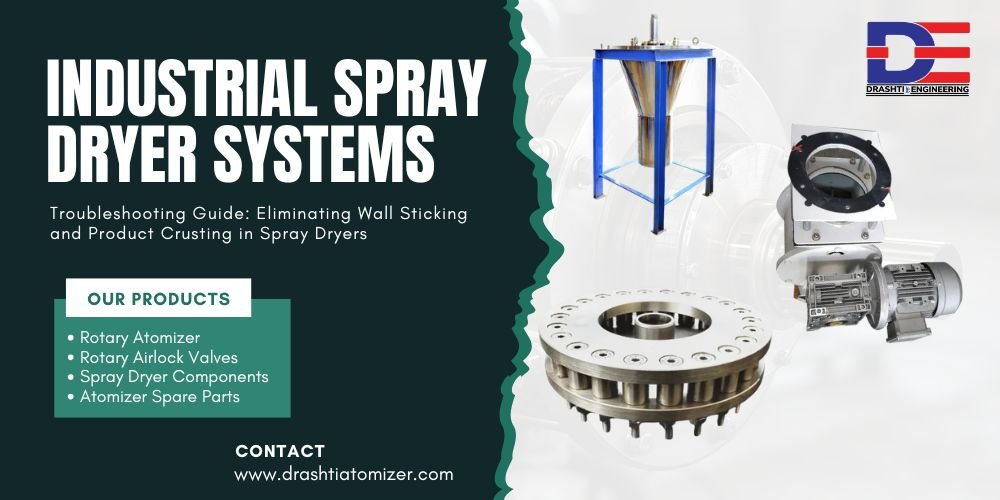
When a Rotary Atomizer Wheel or Disc is precisely engineered, it flings the liquid outward in a perfectly symmetrical, uniform horizontal spray envelope. This gives the droplets enough time to dry completely in the hot air zone before they can physically reach the chamber walls. However, if your atomizer nozzles suffer from minor erosion or microscopic structural alignment issues, the spray pattern becomes distorted. This creates larger, uneven droplets that fly too far while still wet, slamming into the tower walls and instantly building up a sticky crust.
2. Eliminating Spindle Wobble with High-Tensile Shafts
To maintain a flawless, symmetrical atomization cloud, the spinning wheel must operate without the slightest hint of physical distortion. Any microscopic wobble at the spindle level will alter the trajectory of the fluid ejection path.
At our Ahmedabad facility, we prevent mechanical wobble by custom-fabricating replacement Rotary Shafts from premium, high-tensile forged alloys. We precision-grind these shafts on advanced cylindrical machinery down to micro-level straightness tolerances. This ultra-smooth, perfectly concentric finish ensures that your high-speed bearings seat tightly, eliminating the structural vibration that causes uneven fluid distribution and subsequent wall crusting.
3. The Aerodynamic Shockwave: Why Leaky Airlock Valves Cause Sticking
Many plant engineers focus entirely on the top of the tower when troubleshooting wall sticking, completely overlooking the material discharge system at the bottom. A spray dryer operates as a balanced pressure loop. The cyclone at the base relies on a high-precision Rotary Airlock Valve to continuously discharge finished powder while maintaining a absolute air seal.
If your airlock valve is built with loose clearances or has worn-out rotor tips, it introduces a severe system failure known as air leakage. Because the drying tower runs under negative pressure, a leaking valve allows high-pressure ambient air to rush backward up into the system. This upward blast of air travels straight into the main drying chamber, creating turbulent air currents that lift the descending powder mist and push it directly into the upper walls of the machine. Keeping your valves machined to tight 0.1 mm tolerances is critical to maintaining a smooth, downward aerodynamic flow.
4. The Absolute Necessity of Dynamic Balancing
You cannot separate premium fabrication from precision balancing. Any replacement Atomizer Disc or wheel must be dynamically balanced on highly sensitive balancing machines before installation.
An unbalanced wheel introduces a parasitic bending moment along the axis of the shaft. This destructive bending force is directly related to the residual unbalance multiplied by the square of the rotational speed.
Because the mechanical stress increases drastically with the square of the speed, even a tiny residual unbalance at 18,000 RPM creates immense structural forces. These forces create a heavy, continuous mechanical shudder that alters the fluid ejection velocity across different sides of the wheel. This directly causes uneven droplet dispersion, wet wall sticking, and can ultimately snap a high-speed shaft or shatter precision bearings.
5. Sourcing Custom-Engineered Solutions Directly from the Workshop
Using generic, off-the-shelf components from trading middlemen makes it incredibly difficult to solve complex system issues like material crusting. Because every industrial slurry has unique viscosity, drying characteristics, and friction properties, your processing hardware must be custom-tailored to your plant’s specific needs.
Drashti Engineering provides comprehensive, single-source B2B manufacturing. From fabricating wear-resistant Rotary Atomizer Spare Parts with specialized ceramic inserts to performing full-system Atomizer Service & Maintenance overhauls, our engineering team manages the design, machining, and performance testing processes under one roof.